
 By
By There’s a scattering of corpses on the stage, as the main character breathes his poisoned final breath as well. ‘The rest is silence’ whispers Hamlet.
It’s a great line, much used, and well worth re-purposing. Alex Ross used it best, I think, in The Rest Is Noise, his history of twentieth century music.
But it’s slipped into the culture and we all use it. The best man proposes a toast: “Fred saw Sue across a crowded room, and, well, the rest is history.”
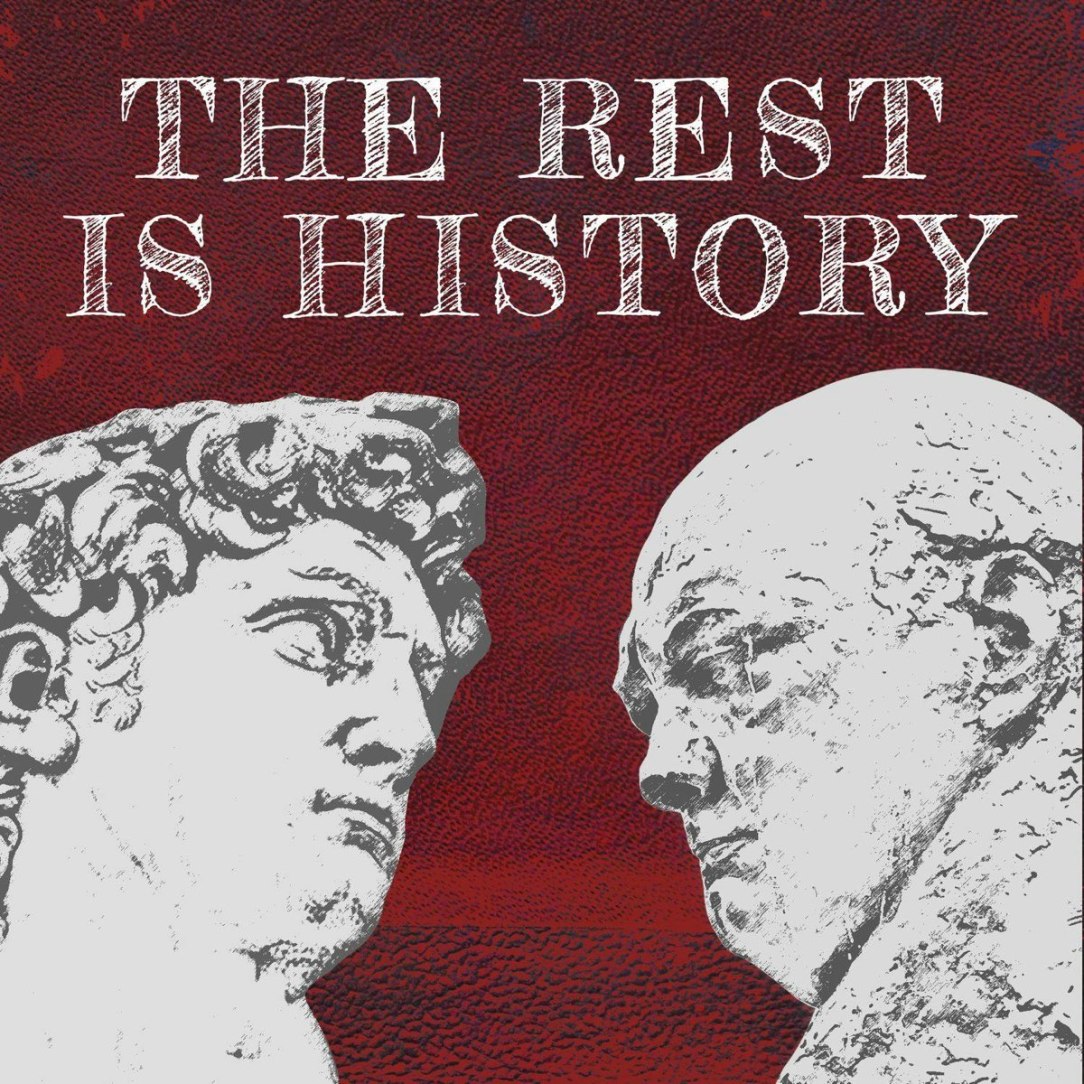
These days, it’s got a new prominence, of course, with the wildly popular Goalhanger podcast, The Rest is History, hosted by Tom Holland and Dominic Sandbrook. Learned, funny, well-read and yet not stuffy, it’s a go-to listen-fest for history geeks everywhere. In-jokes and banter abound, running gags and ‘in-the club’ language are consistent. It can be snortingly silly and schoolboyish (Tom’s impressions spring first to mind), but yet it can be profoundly moving, even shocking. Human history is brutal at times. It has its rivals, like the non-Goalhanger History Hit, with Dan Snow, or the more straightforward BBC’s In Our Time with Melvin Bragg. And it has spawned deeper dives into particular areas too: Empire, with Anita Anand and William Dalrymple; We Have Ways of Making You Talk, hosted by Al Murray and James Holland, The Rest is Classified, with operative-turned-superb-spy-novelist David McCloskey, and journalist, Gordon Corera.
I’m a general fan, as you can gather, but TRIH is the ring that rules them all. It never fails to be fascinating. If you’re a fellow addict, (I’m a Wang, but not an Athelstan)* you’ll know why you love it – and yes, it is that Gordon Corera, of pigeon fame.*
And it’s worth saying that these two chaps seem genuinely likeable, good friends, and it’s a pleasure to say they deserve their success. Which is massive.
Pastors tend to be bookish sorts, and amateur historians in our way as well. Our job involves us explaining the bible, which means we have to have some familiarity with both the ancient Near East and the Classical World. Leave aside Israel, we need to juggle with Hittites and Sumerians, Phoenicians and Philistines, Babylonians and Assyrians, Greeks and Romans.
And then we discover the rich tradition of Christian thinking, two thousand years of it, which all fits into its own contemporary context. Byzantium. Geneva.
But I want to erect three guide rails for us, before we go full into our history-geek mode.
More, not less
First, Tom Holland has acquired quite some prominence in Christian circles for his defence both of the historicity of Jesus and his death, and of the profound and seemingly inescapable impact of Jesus on the Western mind. I won’t argue his case for him – read the brilliant Dominion, which I reviewed when it first came out here. It’s a book I cheerfully press into the hands of sceptical intelligent unbelievers. The podcast frequently gives him space to air the theme of the importance of the ‘sacral’ (his preferred term) to explain how almost every culture has some kind of fundamental spiritual connectivity, and that for the West it is inescapably Christian.
I’m not going to argue that Holland ought to be a more orthodox or explicit or consistent Christian (if he is one) – that’s for him to know and work out. But I’ll say again that from a Christian perspective, emphasising the cross is not enough. The first Christians were equally persuaded of the historicity of the resurrection – so much so, that if that hadn’t happened, our faith is futile. Then the inevitable gift of the Holy Spirit, not only as the public demonstration of Jesus’ victory and reign, but also in the lived experience of every Christian.
This is so much more than saying we need to give talks on the plausibility of the empty tomb. Jesus is unique in human history because he is still alive. And on that historical event we pin our entire hope.
It seems to me that those two elements need equal exposure for the effect of the gospel to be made fully plausible. It is not merely that the cross gives the most powerful example of the validity of suffering and servanthood, which burned into and radicalised the West, but the energising hope and power of the gospel spring from the hope in and power of the risen Christ, and his Spirit.
The History of Ideas
Second, history is — by itself — pretty pointless. I mean it’s interesting and fascinating, and I like the geeky stuff, but in itself it has no more gospel relevance than stamp collecting or train spotting.
Unless we turn it into the history of ideas. That then has massive explanatory force. The wrong kind of history fascination becomes a preacher telling a story as an illustration about an obscure Russian tsar. Yes, that was me. It was crushingly dull.
But make the connections for people, and they’ll become aware of how, in culture after culture, the gospel has shaped how we know and see the world. The confidence of scientists, the conscience of politicians, the creativity of the musicians, the compassion of medics. They all, without exception, have a Christian tap-root. My non-Christian friends who take comfort from the ancient Stoics of Greece and Rome would, I think, have an unpleasant shock if they landed back there. Those cultures were violent, slave-owning kleptocracies, where life was cheap and sex was frequently coercive. It was the gospel which changed that.
History Today
And third, the history of ideas helps us to explain and interpret the contemporary world. How do we come to believe that all people are created equal? Because across history and across our planet that is not an obvious truth. Why do we expect our leaders to be truthful, honest, and just? Why don’t we just give power to the powerful, the wealthy, the violent, the coercive? Why do we limit tyrants rather than give in to the Darwinian logic of supremacy, and the survival of the fittest? Why do we find the dying super-hero such a powerfully comforting story in movie after movie? Why do we look with compassion, and feel guilty when we look away from need?
Which means there is – once again – more work to be done. Lots of people in our churches will love the Tom’n’Dom show (even more won’t, or won’t be aware of it, of course), but if you’re on that wavelength we need to take the extra steps. TRIH is a wonderful resource, as well as hugely fun, but we need to process it before it pops into the sermon. Maybe walk the dog without the AirPods for a change.
Whatever our culture, there are reasons for the assumptions we all make, and with the advent of a shared globalization, those will be more transnational. Some of those reasons will be covertly Christian, and we can explain to a completely unChristian culture why this new value they like holds a particular place for us. Other reasons may be coming into the mix from a Buddhist, or Muslim, or Stoic direction, and we will need to explain to our fellow believers why those are ones we need to resist. And there are the uncomfortable set (Tom Holland is very good at identifying these) which come from what I would call secular Christianity, or partial Christianity, or Christianity run-to-seed, where there is a trace element of Christian morality or values without any biblically shaped energising faith, and which therefore devour themselves. Kindness. Acceptance. Inclusion.
That is, yet again, more time in the study and more time thinking. But the end result should be that on the Ancient and Classical side our messages are more biblically rich, and that on the contemporary side they will have even more cultural cutting edge.
Has a podcast helped you to reframe your thinking? What are the best non-Christian ones you’ve discovered? Pile in!
*An example of the previous mentioned historically informed in-joke


 ministrynutsandbolts.com
I have dipped into TRIH podcast and enjoyed it. It has highlighted my serious lack of historical knowledge and yet when I try to retell a historical episode I have learned about, I struggle to remember the details – I think I am pretty hopeless at remembering details and telling good stories! But at least it gives me some indication of what I don’t know! 😀
Thanks for the post. 🙂