

 By
By Let me share something blindingly simple and obvious. So simple and obvious, in fact, that it’s taken me until I’m old enough to have a bus pass (US readers, = old enough to remember the moon landing) to spot it.
Thinking is really important.
I know.
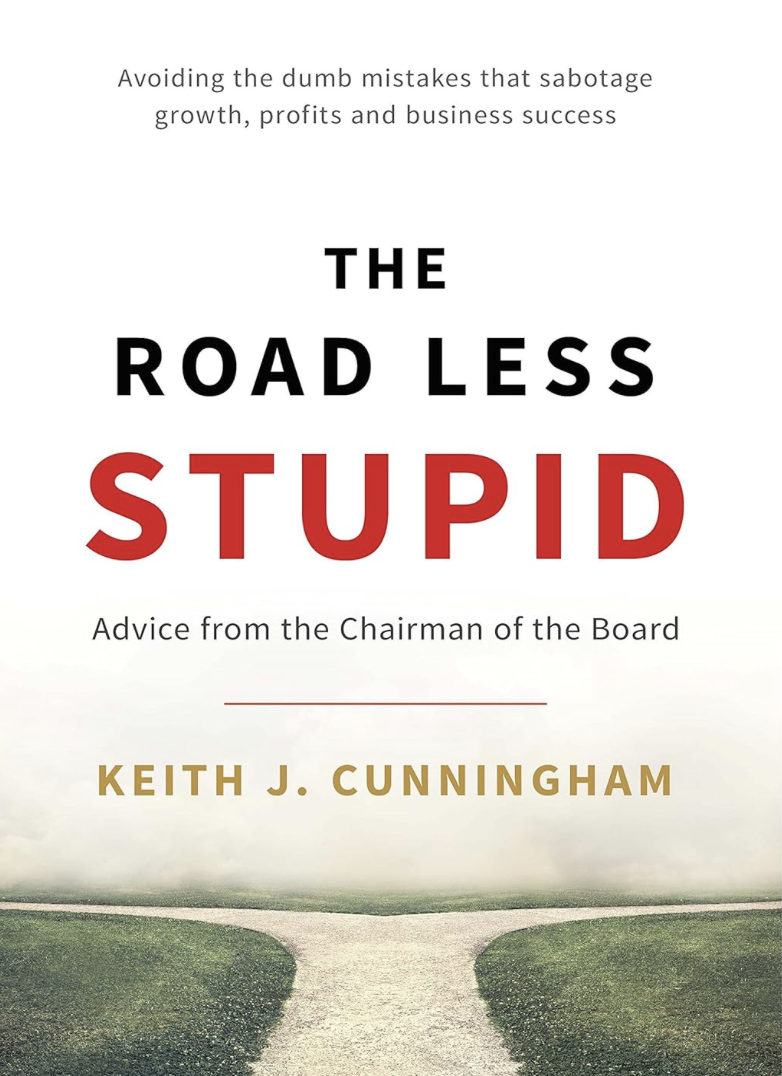
I was put onto it by some posts by Jon Acuff, referencing a book called ‘The Road Less Stupid’, by Keith J. Cunningham. Acuff was raving about it, so I had a look.
It’s a sustained, useful, and immensely practical book about the importance of setting time aside to do nothing but think.
Cunningham doesn’t mean, lie under the apple blossom and gaze at the sky.
He means that one of the most valuable things you can do as a leader is to give long, deliberate thought to problems, or issues, or plans, or goals, or whatever.
(I say, ‘one of’ - I think Cunningham would say ‘the most valuable thing’, but I’m reserving that top spot for praying through Bible. Principle #1 for a Christian seeking The Road Less Stupid admit our foolishness, and go where Wisdom is found. I’m not saying that to sound clever or pious or snarky. I need to remember that)
(Principle #2 still exists, though.)
But I’m allowing my thoughts to wander.
In a nutshell, you could say the book says this: make an hour in your diary. Sit somewhere deliberately not distracting, and make sure already you’ve gone to the loo/made a coffee/given yourself a scratch – i.e. done anything which might get you out that seat. Put your digital devices out of temptation’s way.
Before you do that, though, set a timer for 45 minutes.
Grab an empty pad or notebook, and a pen or pencil, and you’re good to go. Anything with a screen is potentially too distracting. Put the toys out of sight.
Now, you’ve already decided what you’re going to think about. So for the next 45 minutes you’re going to bombard that issue with questions, and come up with answers, suggestions, ideas. For the first five, maybe ten minutes, you’ll come up with stuff you’ve already thought of – no matter. Keep going.
Because after that ten minute line, you’ll come up with new thoughts – bonkers, brilliant, boring, bizarre. Just keep going. Don’t stop. Cover the pad with ideas.
And, as he would say, that lowers the risk of your having to pay the stupidity tax.
(By the way, if you’re distracted by other topics, my suggestion is to start by drawing a vertical line down the middle of the page. Everything relevant to your thinking time goes in the left hand column. ‘Call Toby’, or ‘email the bank’ just gets parked on the right hand side. Get it down, and out of your brain. I’ve written more about that here)
Keep going.
When the alarm goes, then you get to start editing. For fifteen minutes. Cross some ideas out maybe, but start to process the rest. Think about how to action the absolute treasure you’ve mined, because if you’re like me you’ll have unearthed something – maybe one thing – really striking you have never seen before. And you have a ton of other things to mull on as well.
I said that that’s the book in a nutshell; I haven’t really done it justice, by a long way.
“I don’t need to do more smart things. I just need to make fewer dumb mistakes.”
Keith Cunningham
Because not only is it a prolonged call to action, it is absolutely jammed with questions you can ask yourself to see things differently.
If you’re like me, you won’t stop taking notes.
Now, trigger warning: it’s a secular business book – so a lot of his content will need to be recalibrated for those of us working in churches. It talks about things like making money. But I promise you that effort will be worth it. And if you want to read it quickly, it’s chock full of snippets and summaries.
But I’m willing to bet that if you read it fast, you’ll re-read it, slowly.
My testimony – trying this for a few times has been revelatory. Just asking myself ‘What one thing could I do to make the biggest impact on my preaching?’ meant I come up with thirty, forty ideas – and then choose just one, and pursue it.
I’ve bought this book on Kindle, because I wanted to be able to get all my notes out easily at the end – highlight and export to Evernote (if you want to know more, I wrote about how to do it – find it here).
I had the privilege of having a leadership coach for a while, who gave me her undivided attention. At one point I was saying how hard it was to find the time to think (Yes, I said ‘Find’. Not ‘Make’. Rookie error).
And she said, ‘Don’t apologise for thinking. What else do you think leaders do?’
Well, lead, I suppose. But how do we know where, or how, or who…?
Pastors, we spend time in our studies reading, praying, preparing, writing. Those are all good. Essential.
But add one more: thinking.
Choose something that’s bugging you, or maybe just an area of church life drawn at random, and spend an hour asking yourself ‘What am I missing?
And, yes, I am still embarrassed at how basic this sounds and how long it’s taken me to get it. Perhaps I’m the only one.
No, I didn’t think so.
—
At the moment, I can see the book for sale on Kindle, as an Audiobook and a hardback. If you don’t want to go Kindle, I’d wait till the paperback.


 ministrynutsandbolts.com
If you want a free way to listen to the audiobook (for 30 days at least) this is a really good little site… https://www.everand.com/search?query=the%20road%20less%20stupid looking forward to listening to this Chris
Try – it may not be the easiest book to listen to (lots of lists!)